When going through the
ages and looking at the different forms that knowledge transmission has taken,
and the different institutions in which knowledge has been preserved, it’s
impossible to avoid noticing trends. When
the history of knowledge is examined from the standpoint of these institutions,
the ideas proposed by Ian McNeely in his book Reinventing Knowledge seem to almost present themselves. One thing that is certain is the inevitability
of change. I have found, however, that there
are a few things that remain constant in the way that things change. In almost every case, as media and
institutions shift, the new method tries to imitate or reproduce the old, then grows
into its own niche, finally reaching the end of a ‘learning curve’, where a new
institution or medium can meet new needs left by the old medium.
Showing posts with label Brett Riley. Show all posts
Showing posts with label Brett Riley. Show all posts
Tuesday, December 13, 2011

Monday, December 12, 2011
Response to...well...a whole semester of information!
Well, I didn’t do it the way everyone else
did it, and now I like everyone else’s posts better! Oh well.
I studied with the post about the informal blog and the salon in front
of me, and I took notes on the interesting things I remembered, and reviewed
several of the blogs I found most à propos.
I went through after I was finished and tried to organize these more or
less by unit, but it’s far from a perfect science. Anyway, my notes!
Monday, December 5, 2011
A Comment and a Question...
So, I'm working on my paper (don't worry, there *will* be a rough draft tomorrow, it's just a matter of how rough it will be!) and I'm actually having a problem I've never had before. After spending several weeks working on several long papers, I'm suddenly having a really hard time being concise! My last few papers have been much longer, so when I finished my intro and inserted the thesis I had planned on writing, I suddenly realized that I was onto the second page, and I hadn't even gotten to my points yet! I almost wish it were longer...almost. Cutting is still easier than adding, though.
So, here's my thesis, and I'm curious what you think about it. I won't bore you with a long history of publishing, just know that I've been talking about how publishers and authors started off on the right foot, then publishers started to take advantages on authors.
What do you think? I didn't exactly follow Professor Burton's advice, mainly because I haven't found any good arguments against my thesis...yet. I am sure I will have some by Thursday. Excepting that minor detail, what does everyone think?
So, here's my thesis, and I'm curious what you think about it. I won't bore you with a long history of publishing, just know that I've been talking about how publishers and authors started off on the right foot, then publishers started to take advantages on authors.
"How did this
change come about? While there are many
factors that certainly contributed to these changes, it was mainly economic
realities that caused the shift in the balance between these parties that
caused this necessary shift."
What do you think? I didn't exactly follow Professor Burton's advice, mainly because I haven't found any good arguments against my thesis...yet. I am sure I will have some by Thursday. Excepting that minor detail, what does everyone think?
Tuesday, November 29, 2011
Publishers: An Annotated Bibliography
I love libraries. I had actually forgotten how much I loved
libraries; so far in my college experience, I’ve sort of avoided the library,
but making this bibliography (or at least starting it; I’ve found a few more
references I want to track down later) has reminded me how much I enjoy the
time I spend in the library. Actually,
though, it’s probably a good thing that I haven’t been into the library too
often; I have to admit that a large portion of the time I spent there was
actually getting sidetracked by other cool or interesting things. I probably spent the same amount of time
reading extraneous articles as I spent reading books germane to my topic. Oh well, I enjoyed it, so I can’t really say
it was a waste. J
Wednesday, November 16, 2011
The Freschetta Stone
So, for our civilization project over in the Greece Group, we got together and discussed how we wanted to do our artifact and Rosetta thing. Our first thought was that the Greeks, like many other ancient cultures in the Mediterranean area, frequently wrote on papyrus. It seemed easy enough, it is a simple and common medium, but when we tried to get our hands on papyrus, we immediately started running into difficulties. First, we tried online, but the fastest reliable shipment method we could find would have taken a full four days (by which time we needed to be translating our new artifact), so we searched to see if there were any local stores that might have it, to no avail. We considered stone, which was a popular medium at certain Greek time periods, but discarded that idea because of the difficulty of writing into that medium.
 |
| Our Rosetta thing and our received artifact, displayed against The Freschetta box we used to preserve the "Stone" |
Friday, November 11, 2011
Index Librorum Prohibitorum (say that five times fast)
Index
Librorum Prohibitorum
The
first time we talked about the “index” in class, I was immediately interested,
and I’ve been thinking about it and even reading about it since. I think it’s a great way to transition from
written cultures and knowledge directly into more print-based culture.

The opening pages of the document
Friday, November 4, 2011
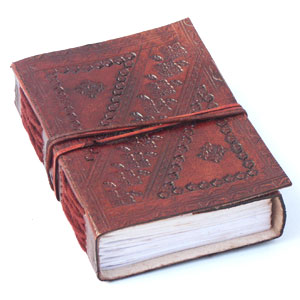
Dear Diary...
In keeping with the last few weeks, I have
decided to again continue research into the history of book writing. While I was researching, I had the idea that
journal writing must have been an interesting topic in the past; with books and paper so hard to come by, I couldn't imagine that people would just go to the store and buy a blank notebook, so I started to do some digging. This week's post is the results.
Friday, October 28, 2011
Back Again to the History of Novels
The history of the novel, part two
As I’ve been researching I’ve found that
the history of novels is still more complicated than I had previously
supposed. Here is a summary of what I’ve
found.
As we discussed in class, biographies are
an important and ancient part of literature.
The first Western biography happened to be an autobiography, as we
discussed in class, Confessions by
Saint Augustine takes the reader through the early part of the Bishop’s life,
from his childhood until his conversion to Christianity and subsequent baptism
at the age of 33.
Wednesday, October 26, 2011
The First Novel
Romance, travel, encounters with the supernatural, and a hero so perfect he seemed to belong in a bygone age.

Friday, October 21, 2011
Romances
I’ve found something I really enjoy to write about this week, and I personally feel like it’s germane to the topic. Like many in
this class, I’m sure, I love reading.
It’s one of my favorite pastimes; I can easily spend hours curled up
with a good book. Who doesn’t look
forward to cold, stormy winter days when you can sit by the fire and read à
volonté? Okay…so maybe I’m a little
unique. Still, I’m betting most of us
love a good book.
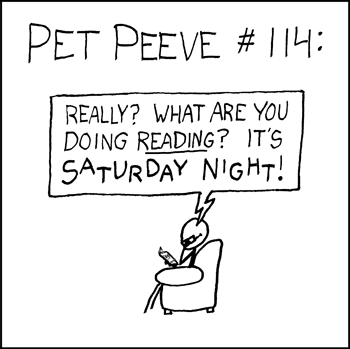 |
| I'm reading a book, that's what I'm doing! credit to: xkcd.com |
Friday, October 14, 2011
My Kingdom for a Writing System!
Again, Friday morning finds me returning*
to the mountainous island of Crete, to visit the ancient woody kingdom of the
Minoans. This time, though, I’m here to
look at ancient writing, not ancient speaking.

*I wish! An island vacation sounds amazing
right now…
 |
| Is this a language? Good question! |
Friday, October 7, 2011
Quoting the Iliad
Let me start by saying that I can take no
credit for finding someone to interview.
After my best efforts, I had found a few people who qualified as people
I could interview, but for various reasons, I was unable to set any kind of
appointment with them. Wednesday
morning, discouraged, I asked in my morning prayer for help finding someone to
interview. My first class that morning
was Book of Mormon with Doctor Seely, and during our class, that discussion
ended up (somehow) on oral functions in the Book of Mormon, and Brother Seely
actually recited the introduction to the Iliad in Greek. Talk about answers
to prayers, right?
 |
| (This is a reconstruction; Minoan palaces don't look like this anymore.) |
Friday, September 30, 2011
Effectively Ending a Culture
How do we know anything about a culture that
once almost completely disappeared? Limited
sources of information make it difficult to define the culture with any
accuracy. It just so happens that the
culture I am going to discuss today is such a culture: the Minoan civilization,
which disappeared more than a thousand years before the beginning of the
Christian era.

Friday, September 23, 2011
Is this not a connection, Glaucon?
For our section on oral knowledge, I have
been assigned the topic of the ancient Minoans, with an emphasis on how they
were portrayed by Euripides in his classic play, Bacchae. As I was thinking
about this assignment, I had an idea that will (hopefully) allow me to connect
our discussions in the last section of the class to the idea of rhetoric in
Greek culture, which, I hope, will transition into Euripides. My idea was to incorporate Socrates into a
post. (hence the title, I hope someone besides me sees the humor?)

Friday, September 16, 2011
Burrito fête, you wonderful thing, you...
So, naturally, I started this assignment wondering what kind of folk knowledge (knowledge that can only be imparted interpersonally, if that's a word) I could possibly pass on to someone. (Is it ironic that I’m doing this
assignment immediately after my blog post about how bullying is a form of passing on folk knowledge? Don't worry, it didn't make the list.)
Here's the list of ideas I had:
Ready or Not...
So, I’ve had something on my mind for a few
weeks that I’ve wanted to take a shot at blogging about, and now, for better or
worse, I’m going to give it a shot!
Wednesday, September 14, 2011
Learning to Run Before You Walk

Well, I went and did it again. Those of you who know me won’t be at all surprised to hear that I’ve bitten off more than I could chew again.
Friday, September 9, 2011
De Nantes à Normandie
As so often happens, a recent discussion about one subject set me off on a tangent, which eventually got me here, writing this blog. The original discussion was about ‘lost’ folk knowledge, things that had fallen out of style or favor, and were no longer passed down except in books, and it reminded me of a rather special culture that I have an extremely vested interest in:

Subscribe to:
Posts (Atom)