 "Japan was ruled by warrior for the better part of a millennium. From the twelfth to the nineteenth century its political history was dominated by the struggle of competing leagues of fighting men. These centuries left a lasting imprint on the country's values and society. Bushi, "fighting men," and samurai, "those who serve," developed a rhetoric with emphases of loyalty and courage and worked out a code that came to be known as "Bushido," the Way of the Warrior."(1)
Friday, September 30, 2011
Bushido
"Japan was ruled by warrior for the better part of a millennium. From the twelfth to the nineteenth century its political history was dominated by the struggle of competing leagues of fighting men. These centuries left a lasting imprint on the country's values and society. Bushi, "fighting men," and samurai, "those who serve," developed a rhetoric with emphases of loyalty and courage and worked out a code that came to be known as "Bushido," the Way of the Warrior."(1)
Effectively Ending a Culture
How do we know anything about a culture that
once almost completely disappeared? Limited
sources of information make it difficult to define the culture with any
accuracy. It just so happens that the
culture I am going to discuss today is such a culture: the Minoan civilization,
which disappeared more than a thousand years before the beginning of the
Christian era.

Thursday, September 29, 2011
Politics of the Kush (and not the kind from a Dr. Dre song)
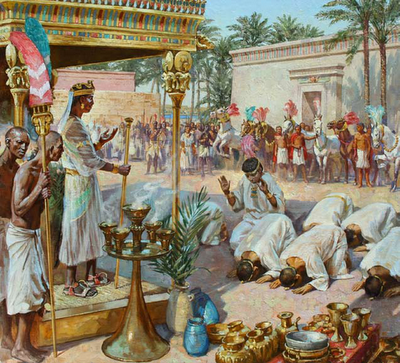
If you're like me, you might not be terribly familiar with the Kush people of Africa, so here's a bit of background... the Kush civilization was a group located in the South of the Nile River valley, mostly in what is the modern day country of Sudan. For most of it's history it was the generally accepted belief that the Kushite culture was a result of the expansion of Egyptian rule into that area, but more recent discoveries in the latter half of the 20th century showed strong evidence that a thriving culture culture existed here prior to the First Egyptian Dynasty, and might have been a very influential force in the development of the Kemites. The Kush Civilization had rich architectural achievements, flourishing trade, a strong belief in divine kingship, and even matriarchy. They were under Egyptian rule for several centuries, but at their high point the Kingdom of Kush, based in Meroe, took control of Kemet and had a very prosperous dynasty of Kushite Pharaohs. But what made political landscape of the Kush kingdom unique?
Wednesday, September 28, 2011
Rice the start of a Civilization
While I was searching for the history of Japan I was having a hard time coming up with what to talk about since I am assigned to talk about civic life but what I decided to talk about is that the Japanese people didn't really come into their own and become a strong united people until they had rice and iron imported into the country at around 100 BC.


Tuesday, September 27, 2011
Persuading Death (Exploring the Mahabharata)
 Those who have a way with words set themselves apart from those who don't. Aptitude for speech and reason gives power to those who possess it. Power to entrance those who hear their voice and fill their souls with emotion - pain, joy, sadness or excitement. Power to convince others to do or believe what the speaker wants. This is the power of rhetoric.
In fact, with enough practice and skill, one can talk their way out of almost anything. But have you ever heard of someone who could talk their way out of death itself? In the Mahabharata, a virtuous woman does just that.
Monday, September 26, 2011
Ni Hao
The Chinese language has often been coined one of the most difficult languages to learn and speak. Not only are there thousands of characters one would need to learn, the language itself is tonal and uses different inflections than the English language.
Other than being a language that dates back centuries, Chinese has evolved to become one of the forefront languages to learn in today's world. But even before its evolution, the language was still a great influence in the ancient dynasties.
Other than being a language that dates back centuries, Chinese has evolved to become one of the forefront languages to learn in today's world. But even before its evolution, the language was still a great influence in the ancient dynasties.
Friday, September 23, 2011
Is this not a connection, Glaucon?
For our section on oral knowledge, I have
been assigned the topic of the ancient Minoans, with an emphasis on how they
were portrayed by Euripides in his classic play, Bacchae. As I was thinking
about this assignment, I had an idea that will (hopefully) allow me to connect
our discussions in the last section of the class to the idea of rhetoric in
Greek culture, which, I hope, will transition into Euripides. My idea was to incorporate Socrates into a
post. (hence the title, I hope someone besides me sees the humor?)

Subscribe to:
Comments (Atom)