The day of reckoning draws dearer, our papers are due tonight! I guess I could've posted about my progress earlier in the week, but as I'm sure we can all attest to, this week has been insane!! Either way I would very much appreciate your input, even at the eleventh hour.
As I'm sure some of you may have already inferred by my comments about it in class, (and I apologize if they've gotten annoying, I just really like this topic) my academic paper is about the political ramifications of applying print to legal texts.
Here's my intro paragraph:
"The American Revolution, the English Civil War, and
the French and Russian Revolutions, all are examples of unprecedented political
and social change that occurred after a particularly pivotal event in history –
then invention of the printing press. The application of printing to the law
led to greater political change than any other singular event in history. This primarily
brought about a change in the way people communicated legal knowledge, and
thereby how they communicated their ideas on the subject. There are two main
results of printed law that directly caused this change: greater public access
to uniform legal decisions and court proceedings, and a more public discourse
regarding law and its functions leading to the wide dissemination of political
ideas. While some may argue that the transition from spoken to written law or
some other turning point in history was more groundbreaking in its nature, it’s
quite apparent that the transition from oral and written legal traditions to
the printed word had an effect with far greater scope than those of other
developments."
In case you didn't catch it, my thesis is, "The application of printing to the law
led to greater political change than any other singular event in history." I think it's simple, provocative, and gets my point across.
What are your thoughts? Did this really lead to more political change than ANY other single event in history? The only one I could think of was possibly The American Revolution, which I believe depended a lot on print knowledge in the first place. I think it's a pretty divisive statement, so I'm sure there will be someone who disagrees with me. Thanks in advance for your input!
Showing posts with label politics. Show all posts
Showing posts with label politics. Show all posts
Thursday, December 8, 2011

Tuesday, October 4, 2011
Law and Religion - Indivisible in India

Last week I posted about my findings while reading from the
Mahabharata, an ancient epic poem written in India that contains key beliefs of
the Hindu culture. I dedicated this week to reading from the Bhagavad-Gita, a sacred scripture taken
from the Mahabharata that is so important to Hinduism that it is often treated
as a free standing text. The poem recounts a conversation between Lord Krishna
(later revealed to be the Supreme Being himself) and a prince named Arjuna who
questions the war he’s fighting against his own cousins. As they stand on the
battlefield with both sides ready for conflict, Lord Krishna (often referred to
simply as “the Lord”) teaches Arjuna his duties as a warrior in the caste
system of India and also instructs him on how to live a righteous life. As
such, this text allows us to have a better understanding of Hindu theology and
the caste system of ancient India.
Thursday, September 29, 2011
Politics of the Kush (and not the kind from a Dr. Dre song)
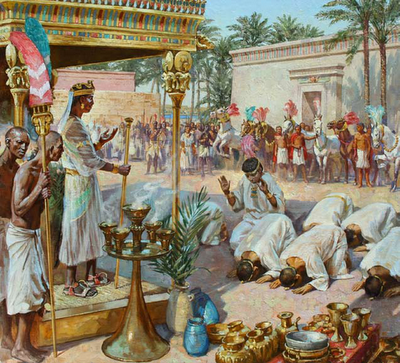
If you're like me, you might not be terribly familiar with the Kush people of Africa, so here's a bit of background... the Kush civilization was a group located in the South of the Nile River valley, mostly in what is the modern day country of Sudan. For most of it's history it was the generally accepted belief that the Kushite culture was a result of the expansion of Egyptian rule into that area, but more recent discoveries in the latter half of the 20th century showed strong evidence that a thriving culture culture existed here prior to the First Egyptian Dynasty, and might have been a very influential force in the development of the Kemites. The Kush Civilization had rich architectural achievements, flourishing trade, a strong belief in divine kingship, and even matriarchy. They were under Egyptian rule for several centuries, but at their high point the Kingdom of Kush, based in Meroe, took control of Kemet and had a very prosperous dynasty of Kushite Pharaohs. But what made political landscape of the Kush kingdom unique?
Subscribe to:
Posts (Atom)